
The Bible for the Common Man
 The focal point of the Protestant Reformation was the Bible being translated and made available in the common languages of the people. People began to read the Bible, and when they did these things happened: 1) Individuals were transformed; 2) The Church began to be changed, putting off corruption; 3) The state was gradually reformed. The fruit of the Reformation was revival of individuals, restoration of the church, and reformation of all society.
God uses individuals to change nations and the course of history. Some of those people God used in the Protestant Reformation included Martin Luther, John Calvin, William Tyndale, and John Knox.
Martin Luther
God used a flawed, rough, and at times, a harsh man to launch a gigantic revolution. Martin Luther stood up against the whole force of the religious establishment. “His profound experience of forgiveness in Christ gave him the courage to stand alone against the entire weight of established and entrenched religious deception and blow it to the winds.”[iii]
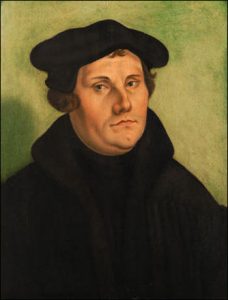 Many things affected Luther’s development. He committed to become a monk after a narrow escape from lightning – he prayed, “If I survive this storm, I will become a monk!”
While at a monastery he read a tract by John Huss, which deeply touched him: “I wondered why a man who could write so Christianly and powerfully had been burned…. I shut the book and turned away with a wounded heart.”[iv]
On a trip to Rome in 1510, he went through every pilgrim devotion possibly — from viewing relics to climbing the stone steps of the Santa Scala on his bare knees. “He earned so many indulgences that he almost wished his parents dead so he could deliver them from purgatory.” But he had no peace. The immorality and corruption he saw horrified him. He described the papal court as “an abomination,” writing that it was “served at supper by six naked girls.”[v]
His fellow monks gave him a Latin Bible that he diligently searched for truth. He came to be convinced that “salvation was a new relationship to God based not on any work of merit on man’s part, but on absolute trust in the divine promises.”[vi]
This and other truths were contained in Luther’s “95 Theses” that he nailed to the church door at Wittenburg on October 31, 1517. His writings that followed addressed many scriptural truths (such as the priesthood of all believers) and ways to reform the corruption in the church and state (including cutting Papal taxes, reducing bulky government, closing brothels, and reforming university education).
“I am,” he pleaded, “but a mere man, and not God; I shall therefore defend myself as Christ did, who said, ‘If I have spoken evil, bear witness of the evil’. . . . For this reason, by the mercy of God I conjure you, most serene Emperor, and you, most illustrious electors and princes, and all men of every degree, to prove from the writings of the prophets and apostles that I have erred.”
“As soon as I am convinced of this, I will retract every error, and will be the first to lay hold of my books, and throw them into the fire. . . . I cannot submit my faith either to the Pope or to the councils, because it is clear as the day that they have frequently erred and contradicted each other.”
“Unless, therefore, I am convinced by the testimony of Scripture, or by the clear reasoning, unless I am persuaded by means of the passages I have quoted, and unless my conscience is thus bound by the Word of God, I cannot and will not retract; for it is unsafe and injurious to act against one’s own conscience. Here I stand, I can do no other: may God help me! Amen.”[viii]
Luther was condemned to death by the state, but since he was promised safe passage beforehand he was allowed to leave. On the road he was abducted by the friendly King Fredrick the Wise who hid him in his castle in Wartburg. Here, he finished much writing, including Scripture translation.
Through his belief in Sola Scriptura (Scripture alone) and his translation of the Bible (in 1534 in German), he helped establish truth amidst the common people — the truth of justification by faith and the place of the Bible in the life of the Christian.
*This article was excerpted from Biblical Revival and the Transformation of Nations. It can be ordered here.
See Mark Beliles and Stephen McDowell, America’s Providential History, Charlottesville, Vir.: Providence Foundation, 2010, pp. 43-44 for more.
[ii] See Foxes Book of Martyrs, Fair Sunshine by Jock Purves, and By Their Blood, Christian Martyrs of the 20th Century by James and Marti Hefley for the stories of some who were persecuted and killed.
[iv] Martin Luther and the Reformation by Beard, quoted in Pratney, p. 37.
[viii] From History of the Christian Church by Henry C. Sheldon, quoted in Rosalie Slater, Teaching and Learning America’s Christian History, San Francisco: Foundation for American Christian Education, 1980, p. 169.